
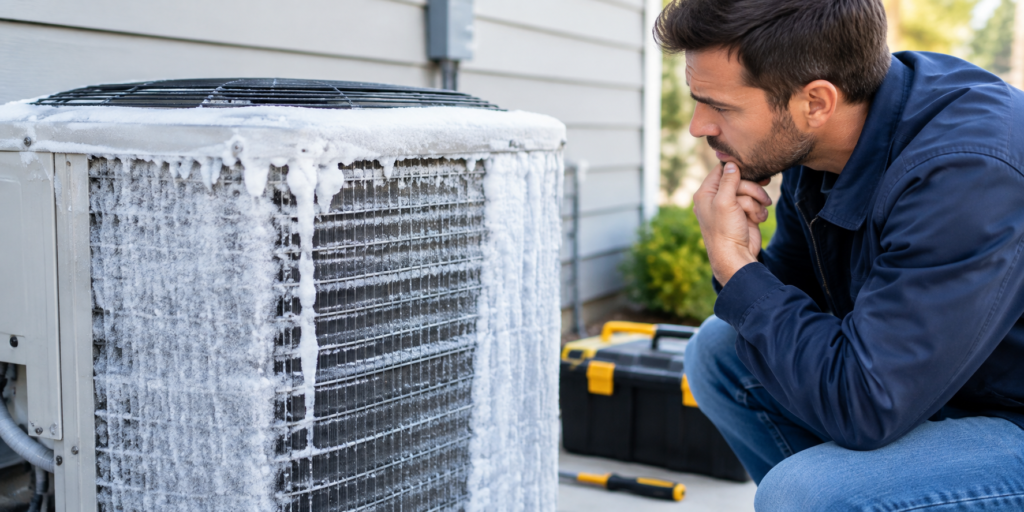
It’s 95°F outside, your air conditioner is running non-stop, and instead of cool air, you’re getting warm air or worse, you open the access panel and find a block of ice sitting on your evaporator coil. It feels backwards. How does a machine built to fight the heat end up frozen solid in the middle of July?
At Teva HVAC LLC, our technicians get this exact call dozens of times every cooling season. The good news: a frozen AC is almost always fixable, and in most cases, preventable. Below, we walk through the six real causes we see in the field, how to tell them apart, and most importantly what to do (and not do) before help arrives.
Key Takeaways
- A frozen AC is not normal, even during extremely hot weather.
- Restricted airflow and low refrigerant are two major causes of frozen coils.
- A dirty air filter can reduce airflow enough to contribute to freezing.
- Turn the cooling system off and allow the ice to thaw before troubleshooting further.
- Never scrape ice from the coil or use a heat source to melt it.
- If the system freezes again after thawing and replacing a dirty filter, schedule an HVAC inspection.
- Repeated freeze-ups can increase stress on the system and may lead to more expensive repairs.
Why Is My AC Freezing Up?
Your air conditioner uses an indoor evaporator coil to absorb heat from the air inside your home. Refrigerant flows through the system while warm indoor air passes across the cold coil.
Under normal conditions, the coil becomes cold enough to remove heat and humidity without freezing. When airflow is restricted or the refrigeration system is not operating correctly, the coil can become too cold. Moisture on the coil can then freeze and form ice.
Once ice starts building up, the problem can become worse because the ice further restricts airflow.
That creates a cycle:
Reduced airflow or another system problem → colder coil → ice formation → even less airflow → reduced cooling.
How to Tell If Your AC Is Actually Frozen
You don’t always need to open a panel to know. Watch for these signs:
- Warm or weak air coming from your supply vents
- A hissing or gurgling sound near the indoor unit
- Water pooling around the indoor air handler (from melting ice)
- Visible frost or ice on the refrigerant lines or coil
- The outdoor unit still running but the house not cooling
If you see even one of these, it’s worth a quick inspection but resist the urge to force the system to “push through it.”
Why Is My AC Unit Freezing Up: 6 Real Causes
1. Restricted Airflow (The #1 Cause)
Your AC’s evaporator coil needs a steady stream of warm indoor air passing over it to stay above freezing. Anything that chokes that airflow, a clogged filter, closed vents, blocked return grilles, or a collapsed duct drops the coil’s temperature until condensation on it turns to ice.
Fix: Replace or clean the air filter every 60–90 days (more often with pets). Make sure at least 75–80% of your supply and return vents stay open, even in unused rooms closing too many vents actually increases pressure and restricts flow.
2. Low Refrigerant Charge or a Leak
This is the cause homeowners most often misdiagnose. A refrigerant leak drops system pressure, which lets the remaining refrigerant expand too much inside the coil, cooling it far below freezing. Unlike a dirty filter, this problem gets worse over time, not better.
Fix: This is not a DIY repair. Refrigerant handling is federally regulated (EPA Section 608), and simply “adding more” without finding the leak just delays the same failure. A licensed technician needs to leak-test the system, repair the source, and recharge to the manufacturer’s exact specification.
3. A Dirty Outdoor Condenser Coil
Homeowners focus on the indoor coil and forget the outdoor unit is half the equation. When the condenser coil outside is caked in dirt, grass clippings, or leaves, the system can’t reject heat properly, which throws off the entire pressure balance and can freeze the indoor coil as a side effect.
Fix: Keep at least 2 feet of clearance around the outdoor unit and hose it down gently each spring (power off first).
4. A Failing Blower Motor or Fan
If the blower motor that pushes air across the evaporator coil is weak, worn out, or wired incorrectly, airflow drops even with a spotless filter and open vents same end result: a frozen coil.
Fix: A weak or noisy blower needs a technician’s diagnosis. This is often a capacitor or motor issue, not something to troubleshoot blind.
5. A Clogged Condensate Drain Line
Less talked about, but common: when the condensate drain backs up, water can pool around the coil and refreeze in the airstream, especially on long cooling cycles.
Fix: Pour a cup of distilled vinegar down the condensate drain line every few months to prevent algae buildup.
6. Running the AC in Unusually Cool Weather
Central AC systems are engineered to run efficiently within a specific outdoor temperature range. Running your AC when nighttime temps drop into the 60s can occasionally freeze the coil, since the system wasn’t designed to reject heat at that low a temperature differential.
Fix: A smart or programmable thermostat with an outdoor temperature lockout feature handles this automatically worth the upgrade if you live somewhere with big day-night temperature swings.
What to Do Right Now If Your AC Is Frozen
- Turn the AC off completely — not just the thermostat, but the system itself. Continuing to run it can damage the compressor.
- Switch the fan to “On” (not Auto) to help circulate air and speed up thawing.
- Give it 2–4 hours to fully defrost before doing anything else.
- Never chip or scrape the ice off — this can puncture the coil and turn a filter problem into a very expensive repair.
- Check and replace the filter while you wait.
- Call a licensed technician if the ice returns after a clean restart that’s a strong sign of refrigerant or mechanical failure, not airflow.
What NOT to Do With a Frozen AC
Avoid these common mistakes:
Don’t Chip the Ice Off: Using a screwdriver, knife, or another sharp object can damage the coil.
Don’t Use a Hair Dryer or Heat Gun: Direct heat can damage HVAC components and create an unnecessary safety risk.
Don’t Keep Running the AC: A frozen system is already showing a problem. Continuing to operate it may make the underlying issue worse.
Don’t Assume More Refrigerant Is Always the Answer: If refrigerant is low, the important question is why.
A professional should determine whether there is a leak or another problem affecting the system.
Can a Frozen AC Damage the Compressor?
Potentially, yes.
A frozen coil indicates that the cooling system is not operating normally. Continuing to operate an iced-up system can put additional stress on components and may turn a relatively manageable problem into a more expensive repair.
That’s why the safest first response is to stop cooling operation and allow the system to thaw before further troubleshooting.
Why Choose Teva HVAC LLC for AC Problems?
When an AC freezes, the goal should not simply be to remove the ice. The real goal is to identify why the coil froze in the first place.
Teva HVAC LLC approaches cooling problems by looking beyond the immediate symptom. Airflow, filters, coils, refrigerant-related concerns, blower operation and overall system performance can all matter when diagnosing a frozen AC.
If your system keeps freezing or stops cooling properly, professional HVAC service can help identify the underlying problem before it develops into a larger repair.
Frequently Asked Questions
Is a frozen AC an emergency?
Not usually life-threatening, but it should be addressed the same day. Running a frozen system continues to stress the compressor, which is the most expensive component to replace.
How long does it take for a frozen AC to thaw?
Typically 1–4 hours with the system off and the fan running, depending on how much ice has built up.
Can I just keep running my AC if it’s frozen?
No. Running a frozen system can force liquid refrigerant back into the compressor, a condition called “slugging” that can cause permanent compressor damage.
Does a frozen AC mean I need a new unit?
Rarely. Most frozen-AC calls are resolved with a filter change, coil cleaning, or minor repair. A full replacement is only needed if there’s a major, unrepairable refrigerant leak or the compressor has already failed.
Prevent It From Happening Again
Every cause above shares one thing in common: they’re all things a routine AC tune-up catches before they become a breakdown. Teva HVAC LLC’s seasonal maintenance visits include a filter check, coil inspection (both indoor and outdoor), refrigerant pressure test, and condensate line flush, the exact checklist that prevents 90% of the frozen-AC calls we run in July and August.
Noticing ice on your AC right now, or want to get ahead of it before peak summer hits? Schedule a service call with Teva HVAC and get a same-week AC repair technician visit.