
Quick Answer
Regular HVAC maintenance should be performed at least twice a year once before the cooling season in spring and again before the heating season in fall. Routine maintenance improves energy efficiency, reduces repair costs, extends equipment lifespan, maintains healthy indoor air quality, and helps prevent emergency HVAC failures during Philadelphia’s hottest and coldest months.
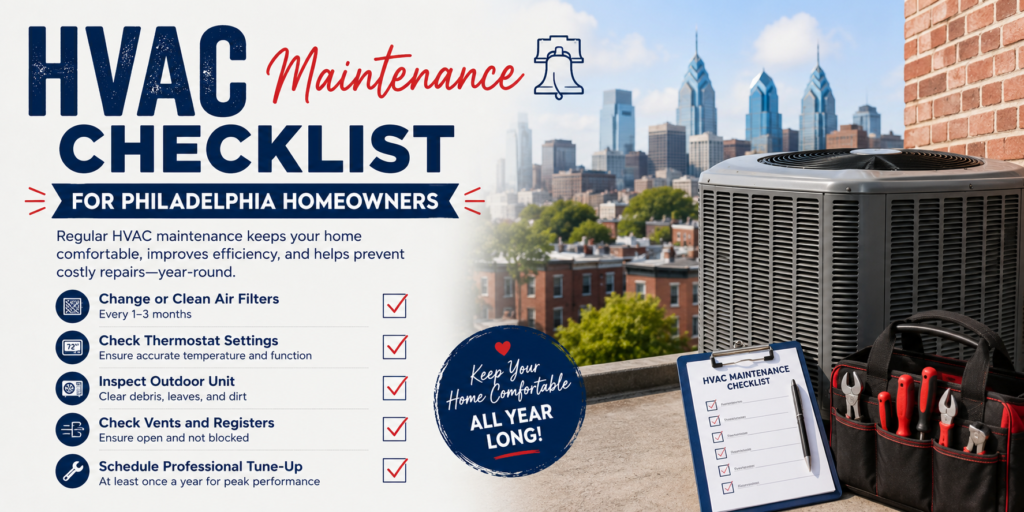
Complete HVAC Maintenance Checklist
Do these tasks each season. Each one takes 5–30 minutes and can prevent a $3,000+ repair or emergency replacement.
| Maintenance Task | Homeowner | HVAC Professional |
|---|---|---|
| Replace air filter | ✔ | |
| Check thermostat settings | ✔ | |
| Clear outdoor condenser | ✔ | |
| Inspect supply vents | ✔ | |
| Clean around indoor unit | ✔ | |
| Flush condensate drain | ✔ | |
| Clean evaporator coils | ✔ | |
| Check refrigerant level | ✔ | |
| Test electrical connections | ✔ | |
| Inspect blower motor | ✔ | |
| Lubricate moving parts | ✔ | |
| Check compressor | ✔ | |
| Test system performance | ✔ | |
| Inspect heat exchanger | ✔ | |
| Carbon monoxide safety test | ✔ |
Seasonal checklist — By Season
🌿 Spring — Prep for AC Season (March–May
- Replace air filter (1-inch filters: every 30–60 days)
- Clear debris from outdoor AC unit
- Test AC by running it on a warm day
- Check refrigerant lines for ice or frost
- Clean condensate drain line with white vinegar
- Schedule professional AC tune-up
☀️ Summer — Peak Cooling Months (June–Aug)
- Change filter monthly in high-humidity months
- Keep outdoor unit shaded — not enclosed
- Set thermostat to “auto,” not “on”
- Look for water pooling near indoor unit
- Ensure vents are open and unblocked
- Listen for unusual noises (banging, hissing)
🍂 Fall — Prep for Heat Season (Sept–Nov)
- Replace air filter before turning on heat
- Test furnace or heat pump before first cold day
- Check carbon monoxide detector batteries
- Inspect flue and chimney for blockages
- Cover or clean outdoor AC unit for winter
- ✓Book pro furnace inspection — don’t wait
❄️ Winter — Keep Heat Flowing (Dec–Feb)
- Keep vents clear of furniture and rugs
- Set thermostat to at least 55°F if away
- Check for frozen pipes near HVAC lines
- Replace filter mid-winter (heavy heating use)
- Keep heat pump outdoor unit clear of snow
- Monitor energy bill for sudden spikes
Annual Professional HVAC Maintenance Checklist
Some maintenance tasks require specialized equipment and should always be performed by a licensed HVAC contractor.
A professional HVAC tune-up typically includes:
- Electrical connection inspection
- Refrigerant pressure testing
- Compressor inspection
- Evaporator coil cleaning
- Condenser coil cleaning
- Blower motor inspection
- Capacitor testing
- Airflow measurement
- Thermostat calibration
- Condensate drain cleaning
- Safety switch testing
- Heat exchanger inspection
- Gas pressure testing
- Carbon monoxide inspection
- Full system performance evaluation
Professional maintenance helps identify worn components before they fail.
Philadelphia-Specific HVAC Tips
Humidity matters. Philly summers are muggy. Your AC also dehumidifies. If rooms feel damp but cool, your system may be undersized or low on refrigerant.
Row homes and twins. Shared walls limit ventilation. Check your attic and basement for duct leaks — common in older Philly homes built before 1980.
Old ductwork is common. Many Philly homes have original 1950s–1970s ducts. Leaky ducts waste 20–30% of conditioned air. A duct seal test costs ~$150 and pays for itself fast.
Hard winters = furnace stress. January in Philadelphia averages 24°F overnight. Book your furnace inspection in September — not December when every tech is booked solid.
HVAC Maintenance Costs in Philadelphia
Here’s what homeowners can generally expect to pay for HVAC maintenance cost Philadelphia services.
| Service | Typical Cost |
|---|---|
| AC tune-up cost Philadelphia | $70–$200 |
| Furnace tune-up | $80–$220 |
| Full HVAC inspection | $150–$400 |
| Annual maintenance plan | $120–$360 |
| Average HVAC service visit | $300–$495 |
Annual maintenance plans often include two seasonal visits, priority scheduling, and discounted repair rates, making them a smart investment for many homeowners.
DIY vs. Call a Pro
Most homeowners can handle monthly tasks themselves. Here’s the line.
🔧 You Can Do This
- Replace air filters
- Clear debris from outdoor unit
- Flush condensate drain
- Change thermostat batteries
- Check and adjust vents
- Test system before season change
👷 Call a Licensed Pro
- →Annual tune-up (required for warranty)
- →Refrigerant check or recharge
- →Duct inspection and sealing
- →Electrical and wiring checks
- →Flue and combustion inspection
- →Any strange noise or smell
⚠️ Safety warning: If you smell burning, hear loud banging, or your system won’t turn on — shut it off immediately and call a licensed HVAC tech. Do not troubleshoot electrical issues yourself.
Recommended HVAC Maintenance Schedule
| Time | Maintenance |
| Every Month | Inspect air filter, thermostat, vents |
| Every 2–3 Months | Replace filter |
| Spring | Complete AC tune-up |
| Summer | Monitor cooling performance |
| Fall | Furnace inspection and heating maintenance |
| Winter | Heating system monitoring |
| Annually | Complete professional HVAC maintenance |
Common Questions Philadelphia Homeowners Ask These
Every 30 days in summer and winter when your system runs constantly. Every 60–90 days in spring and fall. Homes with pets or allergy sufferers: every 30 days, year-round. Philly's summer humidity clogs filters faster than drier climates.
Typically $75–$150 for a single unit. Most companies offer spring AC and fall furnace tune-up bundles for $120–$200. It's the cheapest insurance you can buy for your system.
September for furnace inspections, March for AC tune-ups — before the seasonal rush. Avoid booking in December or July. Techs are slammed and emergency rates apply.
Three likely causes: dirty filter (check first — it's free), low refrigerant, or an undersized unit. In a Philly summer heat wave, also check if your outdoor unit is blocked or sitting in unventilated direct sun.
With annual maintenance: furnaces 15–20 years, AC units 12–15 years. Without it: expect 8–10 years. Philly's extreme seasonal swings are tough on equipment. Maintenance isn't optional — it's what makes the system last.
Yes. PECO (the local utility) offers rebates for high-efficiency HVAC systems. The federal government also offers a 30% tax credit (up to $2,000) for qualifying heat pumps under the Inflation Reduction Act. Ask your installer for current program details.
Need an HVAC Tech in Philadelphia?
Book a seasonal tune-up before the rush — most appointments fill up 3–4 weeks out during peak season.
Or request a free quote online — most companies respond within 2 hours.
