

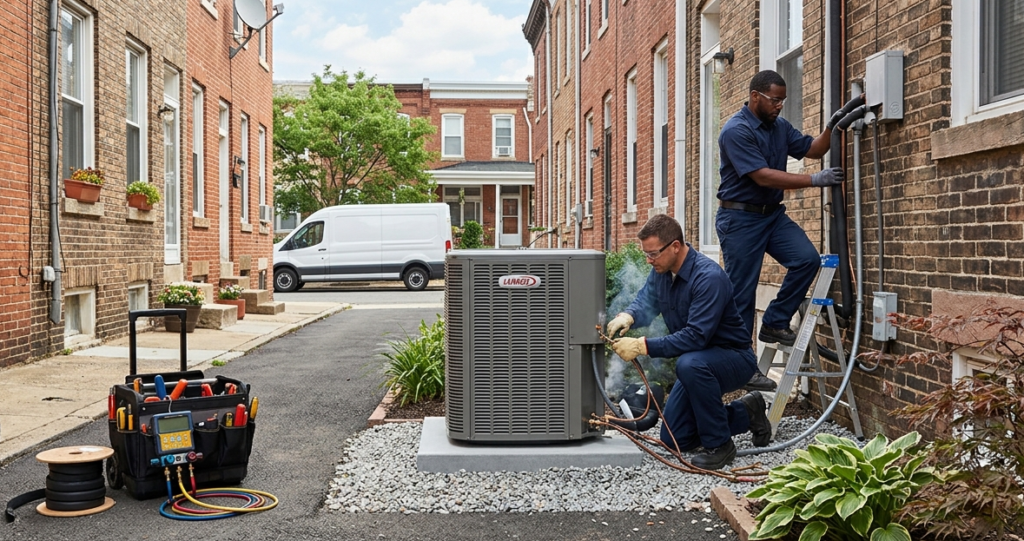
If you’ve been sweating through another Philadelphia summer wondering whether central air is finally worth the investment you’re not alone. Thousands of homeowners across Philly, from Fishtown to Chestnut Hill, ask the same question every spring: how much does it actually cost to install central air conditioning?
The short answer: most Philadelphia homeowners pay between $5,500 and $12,500 for a full central AC installation, including equipment and labor. But that range is wide for good reason your home’s size, existing ductwork, the efficiency of the system you choose, and who installs it all play a major role.
This guide breaks down every complete HVAC installation cost, gives you real 2026 Philadelphia pricing, and tells you exactly what to watch out for when getting quotes. No fluff, no filler just the information you need to make a confident decision.
Quick Answer: What Does Central AC Installation Cost in Philadelphia? Average total cost: $5,500 – $12,500, Basic 2-ton system (smaller home): ~$4,800 – $6,500, Mid-range 3-ton system (average home): ~$6,500 – $9,000 | High-efficiency 4–5 ton system (larger home): ~$9,000 – $14,000+, Homes needing new ductwork: add $3,000 – $7,000.
How Much Does It Cost to Install Central Air?
This is the most common question we hear from Philadelphia homeowners and it deserves a straight answer. The total cost to install central air in a typical Philadelphia home falls between $5,500 and $12,500 for a complete installed system, including the outdoor condenser, indoor air handler or evaporator coil, refrigerant lines, electrical work, and labor. If your home has no existing ductwork, add another $3,000 to $7,000 on top of that.
Several variables pull that number up or down: the size of your home, which system efficiency you choose, the brand, whether your existing ductwork is in good shape, and the specific labor rates in your area. A small 1,000 sq ft row home in South Philly will cost significantly less to cool than a 2,500 sq ft colonial in the Northeast. We cover each of these factors in detail below.
One thing to understand upfront: the price you see advertised online often a low number like “starting at $2,500” almost always refers to the equipment cost only, not the full installed price. When you’re budgeting for central air, always ask for a total installed cost equipment, labor, permits, and any additional work written in a clear quote. That’s the only number that matters.
What’s Included in a Central AC Installation?
Before we get into numbers, it helps to know what you’re actually paying for. A central air conditioner installation is not just buying a box and plugging it in. A proper HVAC installation involves several components working together.
The Main Components
- Outdoor condenser unit: The large unit outside your home that expels heat. This is what most people picture when they think of ‘the AC unit.’
- Indoor air handler or evaporator coil: Works with your furnace or air handler to cool air before it circulates through your home.
- Refrigerant lines: Copper tubing connecting the indoor and outdoor units, carrying refrigerant that absorbs and releases heat.
- Thermostat: Controls when the system runs. Many installs now include smart thermostats like Nest or Ecobee for better efficiency.
- Electrical work: Central AC requires a dedicated circuit. Most installs include running a new circuit breaker line.
- Ductwork (if needed): If your home doesn’t have existing ducts, this is a major additional cost — and one of the biggest variables in your final price.
At Teva HVAC, every HVAC installation in Philadelphia includes a Manual J load calculation to size your system correctly something many contractors skip to save time, but which directly affects your comfort and energy bills for the next 15–20 years.
Central Air Conditioner Installation Cost Breakdown: Philadelphia 2026
Here’s a realistic pricing breakdown based on what Teva HVAC and other reputable Philadelphia contractors are quoting in 2026. These are installed costs meaning equipment plus labor.
| System Type | Unit Cost | Labor Cost | Total Installed Cost |
| 1.5–2 Ton (up to 1,200 sq ft) | $1,200 – $2,200 | $1,500 – $2,500 | $4,800 – $6,500 |
| 2.5–3 Ton (1,200 – 1,800 sq ft) | $1,800 – $3,200 | $1,800 – $3,000 | $6,500 – $9,000 |
| 3.5–4 Ton (1,800 – 2,400 sq ft) | $2,400 – $4,000 | $2,000 – $3,500 | $8,000 – $11,500 |
| 4–5 Ton (2,400 – 3,000+ sq ft) | $3,200 – $5,500 | $2,500 – $4,000 | $9,500 – $14,000 |
| Ductless Mini-Split (per zone) | $800 – $2,000 | $800 – $1,500 | $2,500 – $5,500 |
Note: These prices reflect standard-efficiency SEER2 14–16 systems. High-efficiency SEER2 18–22 units cost more upfront but can cut your cooling bills by 30–40% annually, often paying for themselves within 5–7 years in a climate like Philadelphia’s.
Cost of Installing a Central Air Conditioning System
Now that you’ve seen the price table, it’s worth stepping back and understanding what drives the cost of installing a central air conditioning system and why two homeowners on the same street can get quotes that differ by $4,000 or more. It’s not guesswork — it comes down to five concrete factors.
The total installed cost of a central AC system breaks down roughly like this: 40–55% equipment cost, 30–40% labor, and 10–15% for permits, electrical work, and miscellaneous materials. This means that even if you find a cheaper unit online, the labor and installation costs are largely fixed so chasing the lowest equipment price rarely saves you as much as you’d expect.
There’s also a strong case to be made that the true cost of installing central air conditioning system goes beyond the installation day itself. A standard-efficiency SEER2 14 unit installed for $6,000 may cost you an extra $300–$500 per year in electricity versus a SEER2 18 system installed for $7,500. Over 15 years, that efficiency gap adds up to real money often more than the price difference between the two units. We’ll show you how to calculate that payback in the efficiency section below.
The Biggest Factors That Affect Your Final Cost
1. Does Your Home Have Existing Ductwork?
This is the single biggest variable. If your home already has functioning ducts — common in Philly row homes built after the 1960s you’re in great shape. The installation is straightforward and faster.
If your home has no ductwork (older homes, additions, ranches without forced-air heating), you’re looking at an additional $3,000 to $7,000 for ductwork installation sometimes more, depending on the layout. In these cases, many Philadelphia homeowners choose a ductless mini-split system as an alternative. Ask us about both options.
2. Size of Your Home (Tonnage)
AC systems are sized in tons of cooling capacity not weight. A ton equals 12,000 BTUs per hour of cooling. Bigger isn’t always better: an oversized AC unit will short-cycle, meaning it turns on and off too frequently, leading to higher humidity, more wear, and higher bills. An undersized unit will run constantly and never fully cool your home.
A proper load calculation accounts for your home’s square footage, ceiling height, insulation, window count and orientation, and local climate not just a quick square-footage estimate.
3. SEER2 Rating: Efficiency vs. Upfront Cost
The Seasonal Energy Efficiency Ratio (SEER2) tells you how efficiently a system converts electricity into cooling. In Pennsylvania, the federal minimum is SEER2 14 for new installations as of 2023. Here’s how ratings translate to real costs:
- SEER2 14–15 (Standard): Lowest upfront cost, higher monthly bills. Good if you’re on a tight budget or plan to sell soon.
- SEER2 16–18 (Mid-Efficiency): Best value for most Philadelphia homeowners. Noticeable savings over 10+ years.
- SEER2 19–22 (High-Efficiency): Highest upfront investment, lowest running costs. Ideal if you plan to stay long-term and want maximum comfort.
PECO Energy (the main utility provider in Philadelphia) sometimes offers rebates of $50–$200 for high-efficiency AC units — your installer should check current incentives at the time of purchase.
4. Brand and Equipment Quality
You’ll often hear brand names like Carrier, Trane, Lennox, Rheem, and Goodman come up in HVAC conversations. Here’s the honest truth: the brand matters less than the quality of the installation. A properly installed mid-tier system will outperform a poorly installed premium unit every time.
That said, there are meaningful differences in compressor quality, warranty length (typically 5–10 years on parts, with some brands offering lifetime warranties on heat exchangers), and reliability over 15–20 years of operation.
5. Labor and Permit Costs in Philadelphia
Philadelphia requires permits for HVAC installations, and for good reason unpermitted HVAC work can affect your homeowner’s insurance and create problems when selling. A reputable contractor will pull permits as part of the job.
- Labor typically runs $1,500 – $3,500 for a standard installation in Philadelphia, depending on complexity.
- Permit fees are usually $200 – $450 through the City of Philadelphia Department of Licenses and Inspections (L&I).
- Always ask your contractor if permit fees are included in the quote, or if they’re added later.
Central AC vs. Ductless Mini-Split: Which Makes Sense for Your Home?
Not every Philadelphia home is a good candidate for traditional central air. Here’s a quick comparison to help you think through the options:
| Factor | Central AC | Ductless Mini-Split |
| Home Type | Best for homes with existing ducts | Best for homes without ducts |
| Upfront Cost | $5,500 – $14,000 | $2,500 – $5,500 per zone |
| Efficiency | SEER2 14–22 | SEER2 15–30+ |
| Aesthetics | Vents blend in | Wall-mounted heads visible |
| Whole-home Cooling | Yes — single system | Multi-zone for full home |
| Best For | Larger homes, row homes with ducts | Older homes, additions, garages |
Not sure which is right for your home? Our team can assess your situation and walk you through both options with no pressure. Learn more on our AC repair services.
How to Get the Best Price on Central AC Installation in Philadelphia
Getting a fair price isn’t about finding the cheapest bid — it’s about understanding what you’re buying. Here’s how to protect yourself and get real value.
- Get at least 3 written quotes. A verbal estimate is not a commitment. Any legitimate HVAC contractor will provide a written quote that details equipment model numbers, SEER2 rating, included labor, permit fees, and warranty terms.
- Ask for a Manual J calculation. This is the industry-standard method for sizing your AC system. If a contractor just walks through your home and gives you a number based on square footage alone, that’s a red flag.
- Check for licensing and insurance. In Pennsylvania, HVAC contractors must be licensed. Teva HVAC holds PA HIC License #HIC PA133720 and is fully insured. Always verify before anyone starts work.
- Ask about rebates and financing. High-efficiency equipment often qualifies for PECO rebates and federal tax credits under the Inflation Reduction Act. A good contractor will know what’s available this year.
- Watch for hidden fees. Permit fees, refrigerant disposal, old unit removal, and electrical upgrades are sometimes excluded from base quotes. Ask explicitly about each.
Red Flags to Watch Out For in HVAC Quotes: No written estimate | Quote given without measuring or entering your home | Pressure to decide same-day | No mention of permits | Contractor isn’t licensed or insured | Unusually low quote with vague scope of work (often leads to change orders mid-job).
What Affects Long-Term Operating Costs — Not Just Installation
Your upfront installation cost is only part of the equation. The system you choose today will affect your energy bills every month for the next 15–20 years. Here’s what to keep in mind:
- Annual maintenance: Plan for $80–$150 per year for a seasonal tune-up. This keeps efficiency up and catches problems before they become expensive repairs.
- Air filter replacement: Change your filter every 1–3 months during cooling season. A clogged filter forces your system to work harder, raising bills and shortening system life.
- Smart thermostat savings: Installing a programmable or smart thermostat (Nest, Ecobee) can cut cooling costs by 10–15% annually — a small add-on with meaningful long-term ROI.
- Duct sealing: Leaky ductwork can waste 20–30% of your conditioned air before it reaches your rooms. If you’re adding AC to an older home, a duct inspection is worth the extra hundred dollars.
Frequently Asked Questions
How long does central AC installation take?
A standard central AC installation takes 1–2 days for a home with existing ductwork. Homes requiring new ductwork can take 3–5 days depending on complexity. We always give you a clear timeline before we start.
Do I need a permit to install central air conditioning in Philadelphia?
Yes. Philadelphia requires a mechanical permit for HVAC installations through the Department of Licenses and Inspections. Any licensed contractor should pull this permit as part of the job. Never let a contractor skip this step it protects you legally and ensures the installation is inspected.
Can I install central air in a Philadelphia row home without ductwork?
Yes, this is actually one of the most common projects we do. Depending on your home’s layout, the options include: adding ductwork through interior walls or chases, using a high-velocity mini-duct system (like Unico), or going ductless with a multi-zone mini-split. We’ll recommend the most cost-effective option for your specific home.
What size central AC do I need for my Philadelphia home?
General rule of thumb: 1 ton per 500–600 square feet in a well-insulated home. However, this is a starting point only. The actual calculation depends on your insulation quality, ceiling height, sun exposure, and more. Always insist on a proper Manual J load calculation from your contractor not a rule-of-thumb estimate.
How much can I save with a high-efficiency central AC?
Upgrading from a SEER2 14 to a SEER2 18 system can reduce your cooling bills by 25–30% annually. In a Philadelphia summer, where homeowners run AC for 4–5 months, that adds up to $200–$500 per year in savings for an average-sized home — potentially paying back the efficiency premium within 5–7 years.
The Bottom Line: Is Central AC Worth It in Philadelphia?
For most Philadelphia homeowners, yes absolutely. Central air conditioning not only makes your home dramatically more comfortable during our humid summers, but it also adds resale value and can run at lower per-square-foot cost than maintaining multiple window units.
The key is getting the installation done right. A system that’s properly sized, correctly installed, and permitted protects your investment for 15–20 years. That’s why choosing a experience and licensed Philadelphia HVAC contractor matters far more than chasing the lowest price.
At Teva HVAC, we’ve helped hundreds of Philadelphia homeowners and business owners get comfortable from South Philly row homes to Northeast Philly split-levels to commercial properties across the city. We’re licensed, insured, and give you transparent pricing with no surprises.
| Ready to Install Central AC in Your Philadelphia Home? Stop guessing at costs. Teva HVAC gives you a transparent, written quote — no surprises, no hidden fees. Our NATE-certified technicians serve Philadelphia and surrounding areas with same-week availability. Call (267) 884-2720 | Get a Free Quote → tevahvac.com |
